






Session Cookie Hijacking: Why MFA Should Be Backed by Strong Session Security
Multi-factor authentication (MFA) is a strong front-door lock. It plays an important role in protecting business accounts, but it is not the whole security story.
After you sign in, your browser needs a way to remember that you have already proved who you are. Websites and cloud applications typically use session information, including session cookies or tokens, to maintain that authenticated session.
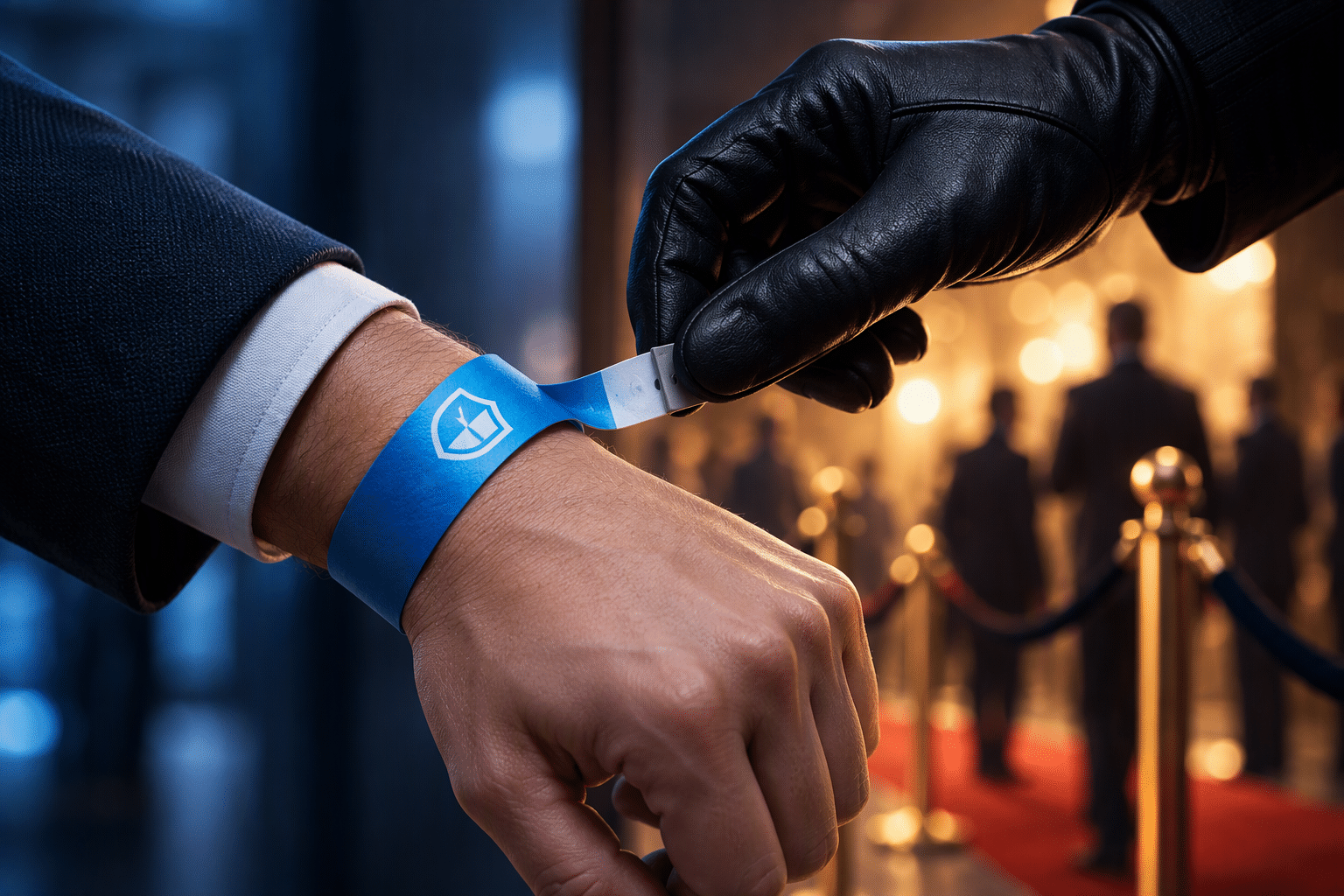
Think of a session token like a wristband at an event. You show your ticket when you enter. From then on, the wristband tells staff that you have already been checked.
Now imagine someone steals that wristband.
They may not need your original ticket because they are attempting to reuse the proof that you have already passed the check.
That is the principle behind session cookie hijacking.
An attacker does not necessarily need to break MFA itself. Instead, they can attempt to obtain and reuse an authenticated session after the legitimate user completes the sign-in process.
That does not mean businesses should stop using MFA.
Quite the opposite.
MFA remains an important security control. Session hijacking simply demonstrates why organisations should surround MFA with stronger identity, device and session protection.
MFA Helps, but There Is More to Keeping Access Secure
Multi-factor authentication makes it significantly harder for someone with a stolen password to access an account.
However, no single security control protects against every attack.
Some attackers focus on what happens after a legitimate user successfully authenticates.
A normal sign-in might look like this:
User signs in → password entered → MFA completed → authenticated session created → session information stored in the browser → access continues while the session remains valid
The session prevents you from having to enter your password and complete MFA every time you open another page.
That convenience matters, but it also makes authenticated sessions valuable targets.
If an attacker obtains usable session information, they may attempt to reuse the authenticated session rather than start the authentication process again. This distinction is important.
MFA protects the authentication process. Session security helps protect what happens after authentication.
Both deserve attention.
For businesses, the lesson is straightforward: deploy MFA, use stronger authentication methods where practical, and do not treat successful authentication as the end of the security process.
What Is a Session Cookie?
When you sign in to a website or cloud application, the service needs to remember that you have already authenticated.
Otherwise, you would constantly need to sign in again as you move between pages and applications. A session allows the service to maintain that authenticated state for a period of time.
A session cookie can contain an identifier associated with that session. Rather than repeatedly asking you to prove your identity, the application recognises the existing authenticated session.
In simple terms, it tells the service:
“This browser has already completed authentication for this session.”
That makes sessions extremely useful to legitimate users and it can also make an authenticated session valuable to an attacker.
Why Would an Attacker Want Your Session Cookie?
Passwords and authentication factors are ways of proving who you are. An authenticated session represents the result of that process. Once you have successfully signed in, an attacker may therefore try to steal the session rather than repeat the authentication process themselves.
A Normal Session
User signs in → MFA is completed → session created → browser retains session information → user receives access
A Hijacked Session
User signs in → session created → attacker obtains usable session information → attacker reuses it → attacker attempts to access the service through the authenticated session
Notice what is missing from the second process.
The attacker is trying to avoid performing fresh authentication because the legitimate user has already done it.
That is why describing every example of session hijacking simply as an “MFA failure” can be misleading.
The attack may target the authenticated session rather than the MFA mechanism itself.
What Happens When a Session Cookie Is Stolen?
People often picture an account takeover beginning with someone guessing or stealing a password.
Modern attacks can be more subtle. An attacker may wait for the user to sign in correctly and then target the authenticated session that follows.
If the application continues to trust stolen session information, an attacker may be able to operate within that user’s authenticated context until the session expires, is revoked or another security control intervenes.
This creates an important question for every organisation:
If someone reused one of your users’ authenticated sessions today, which of your security controls would detect or stop it?
That is a much more useful question than simply asking:
“Do we have MFA?”
MFA is part of the answer, but it is not the entire answer.
Adversary-in-the-Middle (AiTM) Phishing
One important session-theft technique is adversary-in-the-middle phishing, often shortened to AiTM phishing.
In an AiTM attack, an attacker places infrastructure between the user and the legitimate online service. The victim believes they are interacting normally with the service. Behind the scenes, however, the attacker’s infrastructure relays the authentication process.
This distinction matters because the legitimate service may still issue an MFA challenge.
The victim completes it.
The service authenticates them.
The attacker then attempts to obtain the authenticated session information produced by that process.
In other words, an AiTM attack does not necessarily need to crack the MFA mechanism itself.
Instead, the attacker targets what happens after MFA succeeds.
This is why businesses should think beyond passwords and MFA prompts when assessing identity security.
Browser-in-the-Middle Session Stealing
Another technique is known as browser-in-the-middle, or BitM. Rather than concentrating solely on credentials, this type of attack targets the authenticated browser session.
The key principle remains the same:
- The attacker’s objective is the authenticated session.
- They want the access that exists after the user has already proved their identity.
That is why businesses need to protect the complete identity lifecycle rather than concentrating exclusively on the login screen.
Session Theft From a Compromised Device
Phishing is not the only reason session security matters.
Businesses also need to consider the security of the endpoint where authenticated sessions exist. Your laptops, desktops and other corporate devices form part of the wider security boundary.
This is why organisations should not treat identity security and endpoint security as two completely separate problems.
A strong authentication process combined with a poorly protected endpoint can still leave unnecessary risk.
For an organisation using cloud applications or Microsoft 365, it is worth asking:
- Is the user’s device trusted and properly managed?
- Is it securely configured and kept updated?
- Are unusual sign-in and session behaviours monitored?
- Can suspicious sessions be investigated and revoked?
- Do privileged users have stronger security controls?
- Is the organisation using the most appropriate MFA methods for higher-risk accounts?
The objective is to protect the user before, during and after authentication.
Can MFA Stop Session Hijacking?
MFA can greatly strengthen account security, but MFA alone does not guarantee that an authenticated session cannot subsequently be stolen or abused. That is the crucial distinction.
MFA remains worthwhile because attackers who only possess a username and password face another authentication barrier.
However, businesses should make strong MFA part of a wider identity and session security strategy.
Where appropriate, organisations should also consider phishing-resistant authentication, including FIDO2-based authentication methods.
The objective should not simply be:
“Turn on MFA.”
A more mature approach is:
“Use strong MFA and protect the identity, device and session around it.”
How Can Businesses Reduce Session Hijacking Risk?
There is no single switch that removes session hijacking risk.
Businesses should approach the problem through several layers of security.
1. Move Towards Phishing-Resistant Authentication
Not every MFA method provides the same protection.
Where business systems support it and the risk justifies it, organisations should consider phishing-resistant authentication methods such as FIDO2 credentials.
These can include security keys and authentication supported by properly configured trusted devices.
Phishing-resistant authentication can strengthen the login process, but it should still form part of a broader security strategy.
2. Secure the Endpoints That Hold Authenticated Sessions
Account security and device security are closely connected.
Businesses should therefore treat endpoint management, secure configuration, security updates and identity protection as complementary controls.
This becomes particularly important in cloud-first organisations where employees may maintain authenticated access to several business services through a single device.
3. Monitor Suspicious Session Behaviour
Successful authentication should not end security monitoring. Watch for unusual sign-ins, suspicious session activity and unexpected access patterns.
The important point is simple:
Successful authentication should not automatically mean unlimited trust afterwards.
4. Review Session Controls Around Sensitive Applications
A session should not necessarily remain trusted indefinitely simply because somebody authenticated correctly at the beginning.
Organisations should review how sensitive applications handle:
- Session duration
- Reauthentication
- Access from different devices
- Higher-risk activity
- Privileged access
- Session revocation
The appropriate controls will depend on the application, the information it contains and the organisation’s risk profile.
5. Protect Privileged Accounts More Strongly
Administrator and other privileged accounts deserve additional attention because compromising them can expose higher-value systems and security controls.
Stronger authentication, properly managed endpoints, appropriate access restrictions and monitoring should therefore form part of the organisation’s privileged-access strategy.
MFA Is the Baseline, Not the Finish Line
Session cookie hijacking does not make MFA pointless. It makes layered security more important.
MFA still creates a significant additional barrier between a stolen password and your business systems.
But attackers do not have to limit themselves to attacking passwords.
They can target identities and devices. They can use phishing and they can target authenticated sessions.
The answer is not to abandon MFA.
It is to strengthen the security controls around it.
For many businesses, this means combining phishing-resistant authentication, managed endpoints, stronger identity controls, appropriate session policies and security monitoring.
That is the difference between simply having MFA enabled and building a properly defended identity environment.
Is Your Microsoft 365 Environment Protected Beyond MFA?
Having MFA enabled is an important step, but it should not be the end of your security review.
If your business relies on Microsoft 365 and cloud services, your identity security, devices, authentication methods and session controls should work together rather than operate in isolation.
IQ in IT can help you review your Microsoft 365 security, identity controls, endpoint protection and wider secure IT environment to identify where stronger protection may be appropriate.
Speak to IQ in IT about reviewing your security and protecting business access beyond the initial MFA prompt.
Frequently Asked Questions
What is session cookie hijacking?
Session cookie hijacking happens when an attacker obtains usable session information and attempts to reuse an already authenticated user’s session. Rather than starting a new login, the attacker attempts to take advantage of the authenticated session that already exists.
Can session hijacking bypass MFA?
A stolen authenticated session can, in some circumstances, be reused without the attacker completing a fresh MFA challenge. This does not necessarily mean the attacker has broken the MFA system. They may instead be taking advantage of session information created after the legitimate user successfully authenticated.
Does Session Hijacking Mean MFA Is No Longer Worth Using?
No. MFA remains an important security control. It adds another barrier when an attacker obtains a password and significantly strengthens account security compared with relying on passwords alone. The important lesson is that MFA should form part of layered security rather than act as an organisation’s only identity defence.
What Is Phishing-Resistant MFA?
Phishing-resistant MFA uses authentication methods designed to make it much harder for phishing sites to capture or replay authentication credentials. FIDO2-based authentication is an important example. Depending on the environment, this may include security keys or authentication backed by trusted devices.
How Can a Business Improve Protection Against Session Hijacking?
Start by looking beyond the password. Businesses should consider stronger authentication, properly managed endpoints, protection for privileged accounts, appropriate session controls and monitoring for unusual access or session activity. The aim is to protect access throughout the session, not only at the moment the user signs in.





Recent Comments